

Question seven will not move
You are not bad at this. You are stuck on one question, and those are different things.
You are fine at this subject. Not brilliant, but fine. Homework gets done most nights, and the ones you cannot do you usually work out eventually.
Then tonight. Six questions went in forty minutes. Question seven has taken thirty on its own and the page looks exactly the way it did when you started.
So you read it again. The words all mean something individually. You search a bit of it. You find a version with different numbers and an answer at the bottom.
You copy the shape of it. The sheet gets finished at 11:20pm and handed in. It is marked correct.
Then the same idea turns up on a test five weeks later, with nothing to search, and you find out that question seven was never actually done.
Stuck is not one thing
Four kinds, four different first moves.
Almost every stuck question is one of four. The forty minutes go on using the wrong move for the kind you have, usually rereading, which only ever fixes one of them.
Which one is it right now?
So which kind was question seven?
The page was still blank after thirty minutes, so nothing had broken. Nothing had started. That is the second kind: you could say what the question wanted, you could not say which method it wanted, and no amount of rereading was ever going to hand that over.
The move was to ignore the numbers, find one worked example of that type, cover the solution and try to reach line two. Six minutes, and question seven gets finished by you at ten past ten.
Five weeks later the same idea turns up on the test, and this time you have met it with your own pen. That is the whole difference between the two versions of that evening, and it cost six minutes.

Task paralysis: when you cannot start at all
Different problem, same clothes. The work was never what stopped you, the unclear first move was. Naming the kind of stuck is itself the fix here, because the thing blocking you is a decision, not the maths.
So shrink the first move until it is slightly embarrassing: copy out question one by hand, and allow yourself to stop there. You rarely stop there.
Why homework help that hands you the answer backfires
An answer finishes the sheet. A first step finishes the topic.
A finished sheet with a copied answer looks identical to a finished sheet you understood. To your teacher, to your parents, and worst of all to you.
An unfinished question is a flag. A copied one is a flag you burned.
None of which makes copying it a stupid move. At 11pm, with five more questions and a bag to pack, it is the only move that ends the evening. It is just the one that charges you later.
What the answer costs
- Tonight is finished, and that is real
- This one question can be reproduced
- The next one still cannot be started
- The gap stays invisible, including to you
- It reappears in the exam intact
Handed the first step
- Tonight is finished, slightly later
- You did most of the question
- You can start the next one
- You know which bit you were missing
- The gap is closed, not hidden
So the rule is not do not get help. It is do not accept the answer.
The ten minute rule
The first ten minutes are worth more than the next thirty combined.
Struggling is not a waste. The minutes where you are trying and failing are where most of the learning happens, and skipping them by searching straight away is why some people do two hours of homework and remember none of it. But struggle has a shelf life, and it runs out earlier than it feels like it does.
What staying stuck actually buys you
Drag it to however long you sat on the last question you could not do.
30 min
How to focus on homework with ADHD
Ten minutes means pen moving and lines written. Rereading does not count and neither does staring. When the ten is up, stop and ask. Not after one more read. The question does not get easier and you get worse at it.
If your attention leaves the moment a task stops being obvious, the cap matters more, not less. Sitting in the stuck is where the whole evening goes, and a timer you can see turns an open-ended wait into something with an end on it.
Ask for the first step, not the answer
How you ask decides what you get back.
Most people ask badly, get handed an answer, and conclude that asking does not help. The ask is a skill and it is about four words long.
- What type of question is this?
- Give me the first line only
- Which bit of this did I get wrong?
- Why does that step work?
- Do not tell me the answer yet
That last one works on teachers, friends, siblings and chatbots alike. Say it first and the whole exchange changes.
Then show your attempt, especially the wrong one. It tells them where you fell off. A blank page tells them nothing, so they start from the beginning and you learn nothing again.
Steal the method
Five lines, no app required.
- Name the stuck. Words, method, halfway, or the ask.
- Write what you know and what you want, in two lines.
- Ten minutes of pen moving, then stop and ask.
- Ask for the first step. Say do not give me the answer.
- Put the one that beat you somewhere you will meet it again.
Where an app comes into it
All of that works with a pen and somebody patient next to you. At 9:40pm on a Tuesday there is nobody patient next to you, and the thing that is available is the thing that hands you the answer.
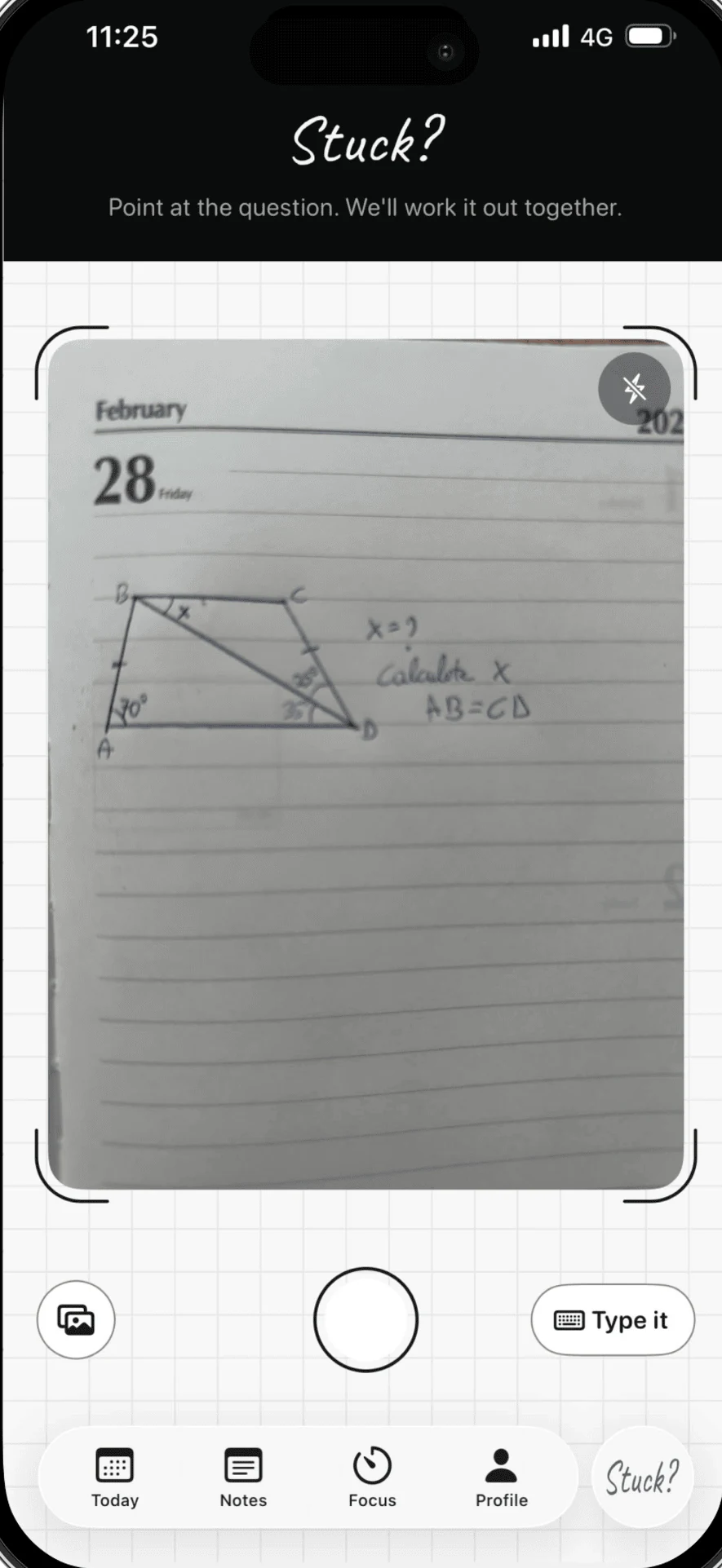
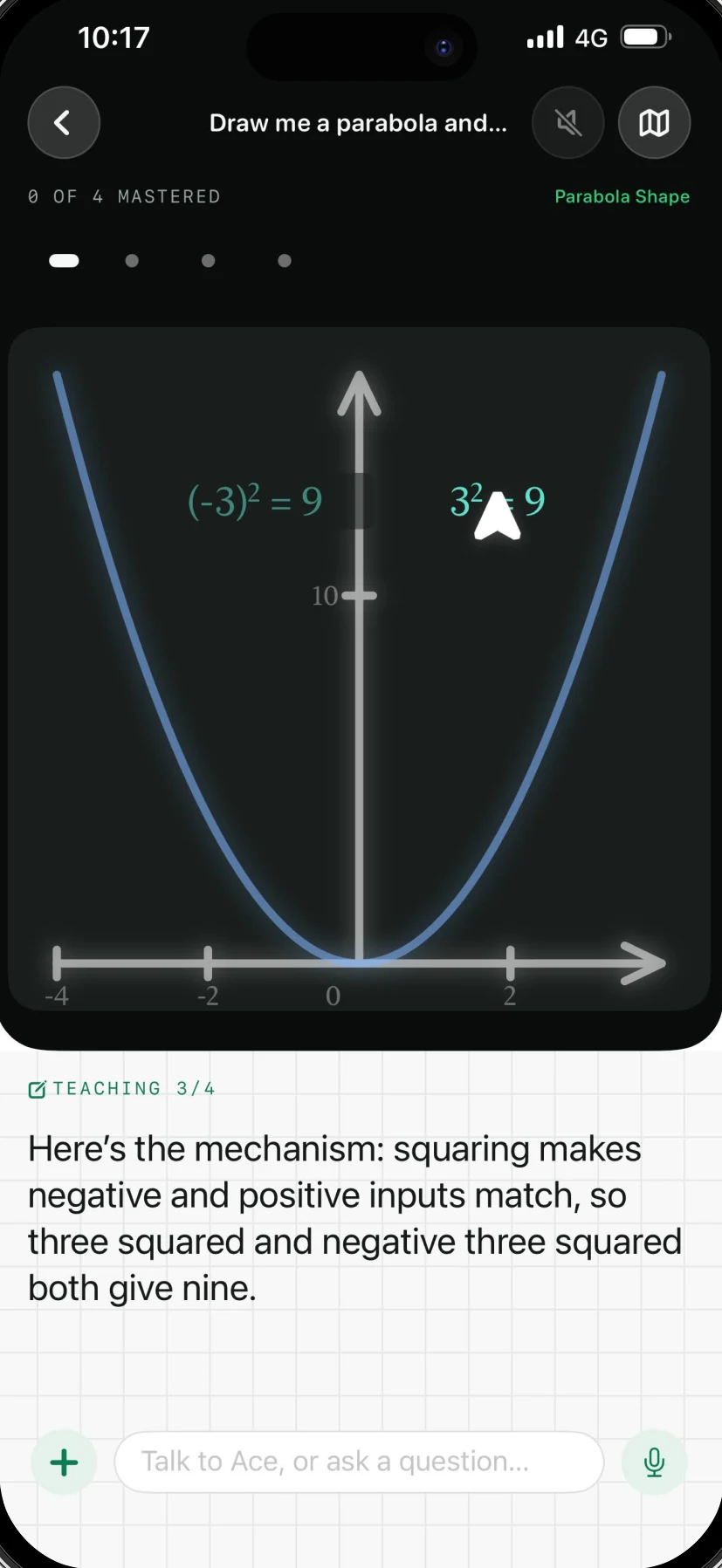
That is the gap Plan2Ace is built for. The app has a button called Stuck. Point the camera at the question and it works it with you rather than at you: first step first, the mechanism explained, the answer last.
If you would rather run it with a pen, run it with a pen. The five lines above are the whole of it.
Questions students ask
How long should I stay stuck before asking for help?
About ten minutes of real effort, meaning pen moving and lines written rather than rereading. The first ten minutes are where most of the learning happens. After that you are reading the same line with more panic and it buys almost nothing.
Is it cheating to look up the answer?
The real problem is not the rule, it is that the answer teaches you nothing. You copy it, the sheet gets handed in, and the gap is still there in the exam where nobody can look anything up. Ask for the first step instead.
What if I do not even understand the question?
Say it out loud in one sentence starting with the word find. If you cannot finish that sentence, that is the thing to ask about, and it is a much better question than I do not get it.
Why can I not start my homework at all?
Usually because the first move is unclear, not because the work is hard. Shrink it until it is almost silly. Copy out question one by hand and allow yourself to stop there. You rarely stop there.
How do I focus on homework with ADHD?
Cut the number of decisions rather than trying harder. Same desk, same time, phone in another room, one question rather than one topic, timer visible. Decide the first line in advance so starting does not need willpower.
Why does homework take so long with ADHD?
Usually not because the work is slower, but because the gaps between the work are longer. The stuck stretches, the restart costs something every time, and an hour of homework fills three. Capping the stuck at ten minutes is what shortens the evening, not working faster.
How do I stop procrastinating homework with ADHD?
Stop treating starting as a willpower problem. Decide the first physical line before you sit down, so there is nothing to choose at the moment you have the least capacity to choose. Copy out question one by hand. That is the whole first task.
It is due tomorrow and I have not started. What now?
Do every question you can do first, fast, and leave gaps for the ones you cannot. Then spend what is left on the gaps. Finishing the easy eighty percent badly beats perfecting question one at midnight.
Stuck on something right now?
Point the camera at it. Free to start.
Download on theApp StoreiPhone, iOS 26.5 or later